For side sleepers, a sleeping bag liner needs enough usable room for bent knees and changes in position. Overall length alone does not answer that question. The shape of the liner, the space inside your sleeping bag and how easily the fabric follows your movement all deserve attention.
There is no single liner shape that will suit every side sleeper. A short test with your actual sleep setup can reveal more than a broad promise of comfort.
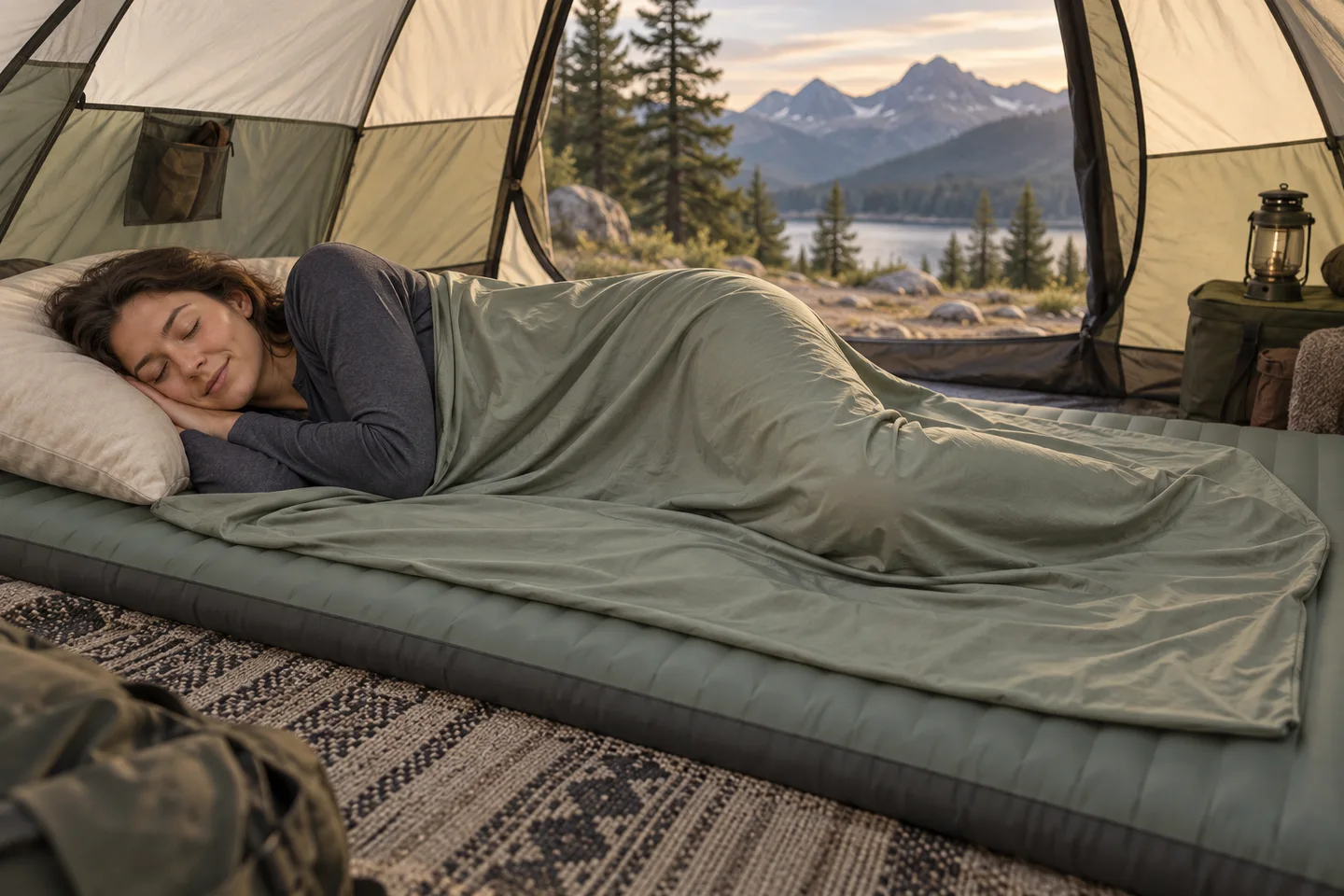
Start with your knees and hips
Think about your normal position. Do you keep your legs fairly straight, draw both knees upward or lift one knee farther than the other? Each position asks the liner to accommodate a different shape.
A rectangular design can offer consistent width along much of its length, while a tapered design has less fabric toward the feet. Neither label establishes the fit by itself. Check the actual dimensions and whether the material stretches, especially around your knees.
If stretch is not described, ask the seller. Do not assume that a soft fabric is also elastic.
Test the whole sleep setup
A liner may feel roomy on a bed but restrictive inside a narrow sleeping bag. Put it into the bag you plan to carry and lie on your usual sleeping pad or mattress. Use your regular pillow and planned sleep clothing.
Turn from your left side to your right side a few times. Notice whether the liner moves with you, stays under you or gathers near your knees. Also check whether your outer bag is the part limiting movement. Buying a wider liner will not solve an outer bag that is already too tight.

Troubleshoot twisting one change at a time
First, unfold the liner completely and align its foot end with the foot end of the sleeping bag. Smooth any large folds before getting inside. Check that a section of fabric has not caught beneath your hip or heel.
If twisting continues, test the liner on a bed without the outer bag. Then repeat the test with your normal sleep clothing. This helps you identify whether the problem is the liner's fit, its interaction with the bag or the way the fabrics move together.
Avoid attaching the liner to your sleeping bag with improvised pins or tight cords. If a product has manufacturer-provided attachment points, follow its instructions. Otherwise, persistent twisting may be a reason to choose a different fit.
Consider getting in and out
Entry design can matter as much as room once you are inside. Check whether the liner opens from the top, along one side or in another way. A large opening may make entry easier, but the relevant detail is the actual opening size and construction.
Try sitting up and exiting without putting all your weight on the edge of the fabric. This is particularly useful if you expect to use a small tent or a confined bunk.
What should a side sleeper buy?
Choose based on measured space and a movement test, with a return policy that lets you assess fit appropriately. Our general buying guide covers additional considerations. Check the BreenHill product page for current information and ask for any construction details that are not shown.