A sleeping bag liner fits well when you can lie in your usual position, move your feet and turn over without pulling the fabric tight. The dimensions on a product page are a starting point, but they do not describe every part of that experience. Your height, sleeping position and outer sleeping bag all affect the result.
Use this sleeping bag liner size guide to compare measurements before ordering and check the fit at home before packing.
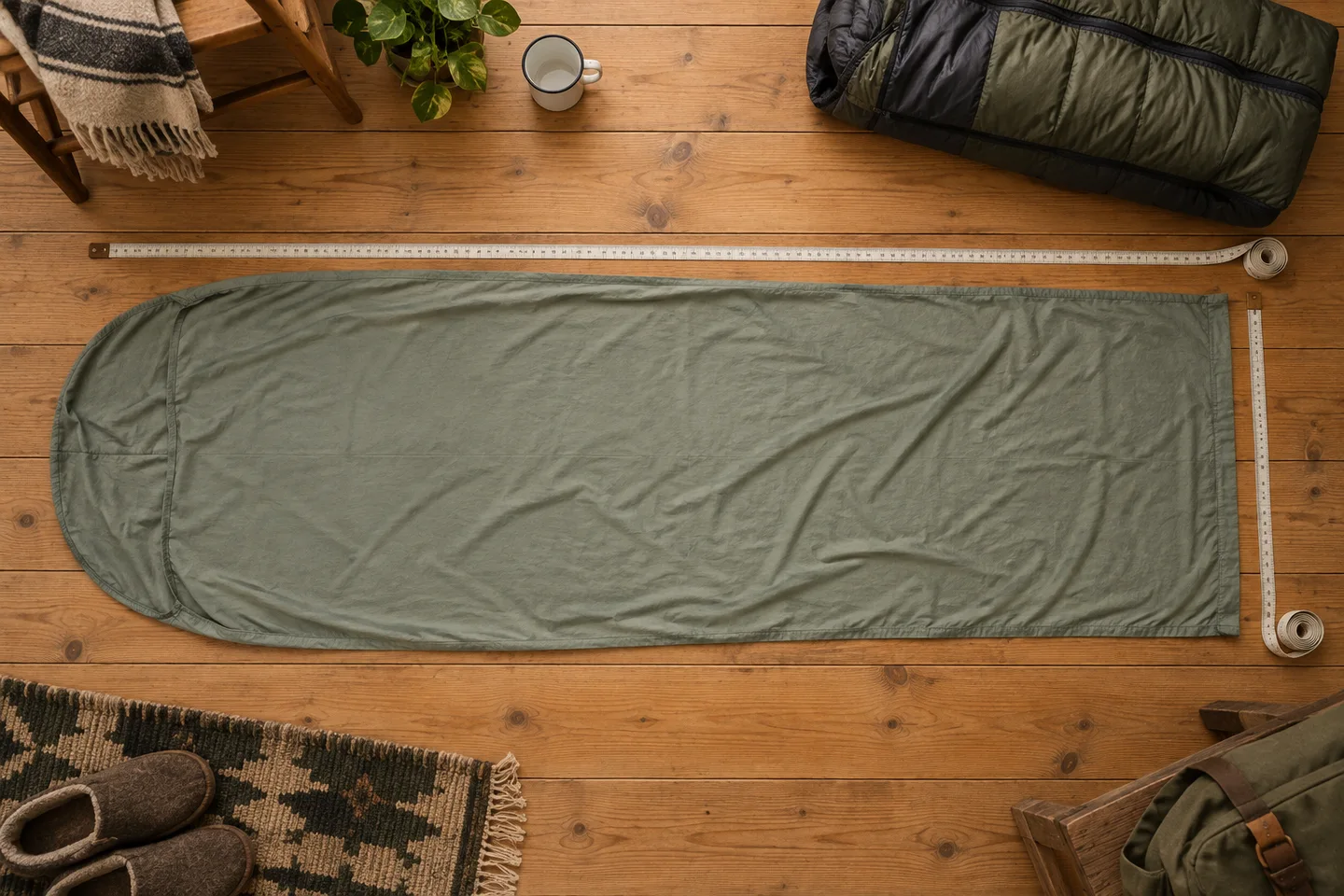
Find out what the measurements include
Ask whether the listed length describes the entire product or the usable body section. A pillow pocket, folded opening or shaped top can make those measurements different. Likewise, a width measured across flat fabric is not a recommended body circumference.
For a simple fabric tube, twice the flat width gives an approximate fabric perimeter. That calculation still does not establish comfortable capacity: seams, taper, stretch and the space needed to move affect fit. Avoid buying a liner that only matches your measurements when stretched tight.
If a listing does not explain its dimensions, request a diagram showing the opening, shoulder area and foot section. This is more useful than an unsupported claim that one size fits everyone.
Check length in your sleeping position
Lie down as you normally sleep and notice where your toes point. Then consider whether you sleep with your knees bent, your arms overhead or a pillow inside the liner. These positions use the available fabric differently.
For taller sleepers, ask for the manufacturer's recommended user height as well as the overall length. Do not assume that a liner with the same nominal length as another model has the same usable space.
Compare width at more than one point
Shoulder room matters when lying on your back, while hip and knee room become more noticeable when turning onto your side. A tapered liner may provide enough room at the top but feel restrictive around bent knees.
Use your current sleeping bag as part of the comparison. A roomy liner cannot create additional space inside a narrow bag. Conversely, excess liner fabric may gather inside a close-fitting footbox.

Run a short fit test at home
Place the liner inside the sleeping bag or bedding you intend to use. Wear your planned sleep clothing, then:
- Enter and exit without pulling hard on the seams.
- Lie on your back and on each side.
- Bend one knee and move both feet.
- Turn over several times and check for bunching.
- Confirm that the top stays in a comfortable position below your face.
If the fit works only when everything is carefully arranged, consider how it will feel when you are tired or moving during the night.
Questions to settle before ordering
Ask about usable length, flat width, footbox shape, fabric stretch and the return policy. For an overview of the other buying factors, see our sleeping bag liner buying guide.
You can also review the BreenHill product information and request any missing fit details. A clear measurement and a realistic movement test are more useful than choosing by the word “large” alone.